
There have been many doomsday predictions about artificial intelligence and mass unemployment since the 2022 AI boom.
One particularprediction from an “Oklahoma expert” indicated that AI will lead to a global population collapse by the year 2300. Not only this, but he also stated that AI will also drop the census from 8 billion to just 100 million.
His reason for this prediction is that as robots and AI systems take jobs, people won’t be able to afford kids and will stop having them altogether.
Here’s why this scenario isn’t grounded in economic reality, and why PWC data shows the future is less dystopian than we make it out to be.
Much of the alarm around AI and job loss comes from the human tendency to focus on worst-case scenarios. We tend to imagine bad experiences and forget that the good ones might actually happen.
The same is happening with AI today.
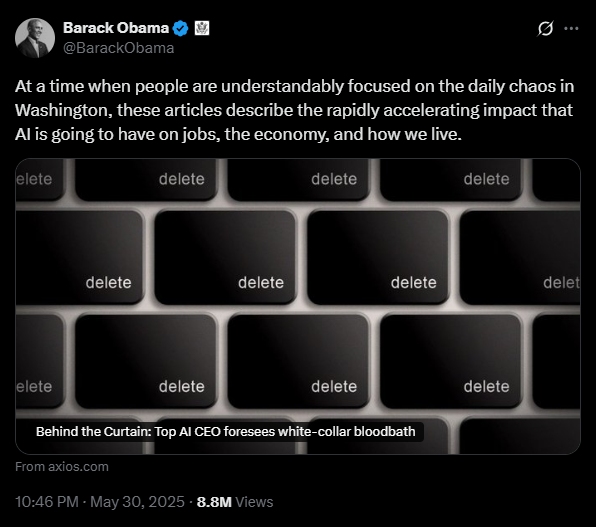
Even people like former President Barack Obama have publicly expressed concern about AI displacing workers. Some experts have even noted that up to half of all entry-level white-collar jobs could disappear in the next five years.
Some early data even supports this scenario, with hiring for junior software engineers reportedly dropping 24% in 2024. In addition, unemployment among recent U.S. graduates has spiked. This is especially true for fields like computer science and finance.
But while the fears are real, they may not show the full picture.
New research from PwC turns the script on the narrative of job destruction. PwC analyzed over one billion job postings and thousands of corporate financial reports. By the end of the survey, results showed that AI is boosting worker productivity. It is also growing company revenue and even driving up wages.
Some more findings showed that in industries that have embraced AI, productivity per employee has nearly quadrupled.
Wages in these sectors are rising twice as fast as in industries less exposed to AI.
In addition, contrary to popular belief, job numbers are growing, even in roles considered “automatable.”
Finally, workers with in-demand AI skills, like prompt engineering, are commanding 56% higher pay.
The conclusion for this is that AI isn’t just replacing workers. It’s making them more valuable.
A Pew survey found that 42.3% of U.S. workers are already using generative AI tools in their daily jobs. On average, they use AI for about a third of their tasks and in doing so, they’ve tripled their productivity. Something that used to take 90 minutes now takes just 30.
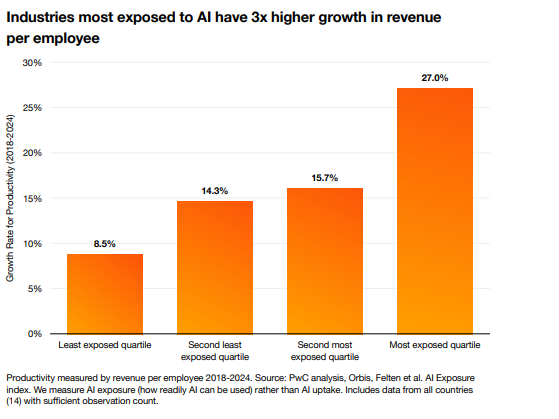
This increase in efficiency is good news for both workers and employers. It allows employees to offload routine or repetitive tasks to AI systems. It frees them up to focus on higher-value work or things that require creativity, judgment and collaboration.
Even in highly automatable jobs like customer service, AI has had a surprisingly positive effect. Rather than eliminating roles entirely, companies are using automation to augment workers, not replace them.
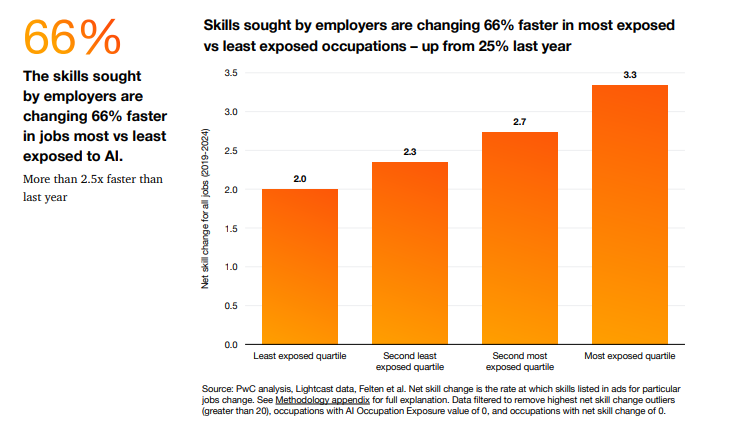
There’s one important caveat though: workers will need to keep up. The PwC report shows that skill demands are changing quickly in AI-exposed industries. In fact, this trend is 66% faster than in other sectors. That means reskilling and upskilling have become more important than ever.
Fortunately, many of the most in-demand skills are learnable and accessible. Prompt engineering, data literacy and critical thinking are all abilities that can be developed without a PhD in computer science.
Even better, companies are increasingly recognizing the need to invest in training to support this transition.
The report shows that workers who embrace these changes early will benefit the most. They’ll get higher pay, more opportunities and greater job security.
In all, it is important to note that the future isn’t a dystopia. It is likely more optimistic than many would have us believe.
Disclaimer: Voice of Crypto aims to deliver accurate and up-to-date information, but it will not be responsible for any missing facts or inaccurate information. Cryptocurrencies are highly volatile financial assets, so research and make your own financial decisions.


