
Think of this:
A refrigerator that not only reminds you to buy milk but also places the order for you. It does this and then selects the best delivery option.
Outside of the average house, you can also think of a smart supply chain system that reroutes a cargo ship in real time to avoid storms. More importantly, it does this without waiting for human approval.
These scenarios are no longer science fiction; they are a reality. They are already happening, and AI is being applied across areas like commerce, logistics and everyday life.
Amazon might be at the center of this change, with the way it is building autonomous AI agents that act with independence and intelligence.
Autonomous AI agents are different from traditional chatbots or machines that perform repetitive actions.
Instead of relying on explicit human instructions for every step, they are more concerned with larger goals and are trained to figure out the best way to achieve them.
They plan, act and adjust based on the information available to them. Some of their features include goal-driven reasoning. They can also divide complex tasks into smaller parts and even execute solutions without oversight.
Amazon has become one of the most important builders of these systems.
Before the AI boom, it already had influence in e-commerce, cloud computing, and machine learning. This means that it has both the data and infrastructure needed to lead.
Amazon is already using AWS to provide these services on the internet. It is also extending this into agentic systems that can be used in areas like logistics, fraud prevention, and even personalized shopping.
Autonomous agents are built on a stack of technologies. At the top are the large-scale neural networks (known as foundation models) and large language models.
Amazon has even invested in its own model family, including Nova. For context, Nova is designed for several generative AI tasks, alongside third-party models from Anthropic, Cohere and AI21 Labs.
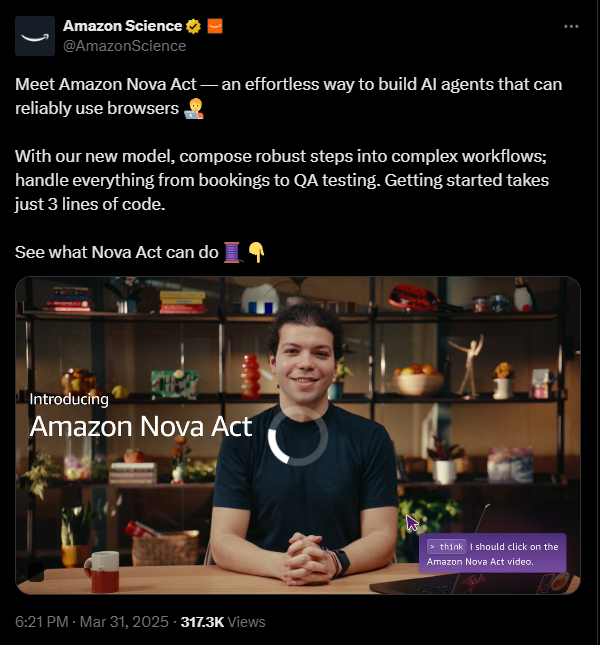
This gives developers flexibility when it comes to choosing the right system for a given use case.
More interestingly, the process from “user request” to “completed task” is fairly structured. It is called an agentic stack, and here’s how it flows:
: Agents first interpret input. This can be text, voice or sensor readings from a machine. This step allows them to understand the environment or the problem presented.
: After identifying a goal, the agent uses its model to map out the required steps needed to reach that goal. For instance, booking a flight requires checking schedules, comparing fares, securing payment and confirming the reservation.
: Agents also keep short-term memory to sustain a task or conversation. However, they can sometimes use long-term memory, which they store in vector databases, to learn from previous data.
: In order to take meaningful action, agents then call external APIs. As an example, for a shopping task, the sequence of steps could include payment processing and inventory checks. For logistics, it could involve a warehouse robot interface or a delivery scheduling system.
All these features are integrated within AWS services.
Bedrock Agents provide the framework to design and deploy autonomous systems. Developers can also gain further support from Amazon Q Developer, which can assist with coding and debugging.
Amazon SageMaker provides the machine learning aspect to train/manage the underlying models. Together, these services allow Amazon to push agent technology to new highs.
Amazon has already started to embed autonomous agents into many parts of its internal operations.
The most visible of these are in retail, where agents are already carrying out what some call “zero-click commerce.”

Instead of browsing and placing orders, customers can now find items automatically restocked based on their usage patterns.
For example, an agent monitoring a cupboard (or a fridge) could reorder things like coffee or detergent before they run out.
More than shopping, though, agents are also improving logistics.
For example, fulfillment centers can use fleets of robots (guided by agent systems) to sort packages, route goods and even maintain stock levels.
This automation can do much to reduce delays and increase throughput. More interestingly, they can also respond to disruptions in real time. On a much wider scale (like global shipping, for example), agents can manage rerouting automatically.
This can be useful for avoiding delays caused by weather or congestion.
These applications show just how deep autonomous AI has gone into daily commerce. Most times, the customer doesn’t even notice what’s going on.
Such a change is much less about creating entirely new services and more about making current ones better.
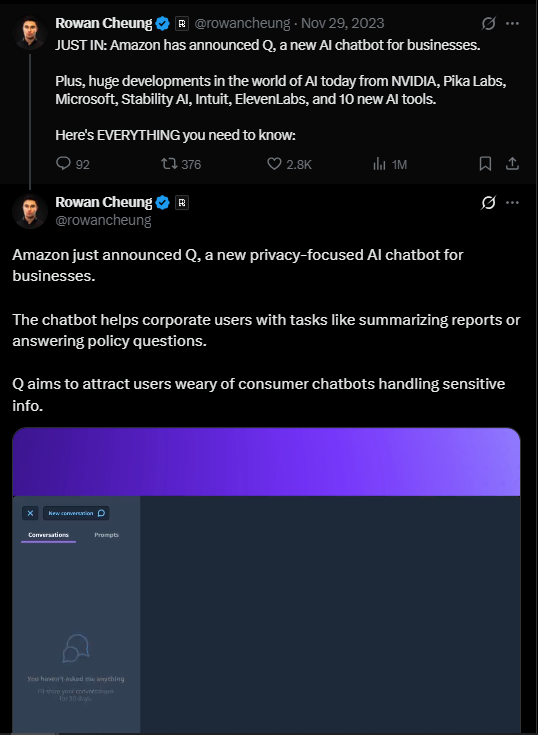
The influence of autonomous agents goes even further than this. For example, Amazon Q (a generative AI assistant) works as an autonomous analyst for corporate teams.
What this means is that employees can ask it to assess things like sales growth across regions or identify drivers of customer churn. It then pulls from multiple databases, analyzes the results and provides detailed explanations (rather than just raw numbers).
In customer service, Amazon Connect also uses autonomous agents to manage initial interactions.
These agents can resolve straightforward issues on their own and then pass some of the more complex cases to human staff. This reduces wait times drastically.
Data-heavy sectors can also benefit from agent-driven systems.
Businesses can use agents to compile financial records, inventory data, or even supply chain metrics. These agents analyze enormous datasets quickly and can improve decision-making without requiring any manual reviews.
Autonomous agents are more than just technological progress. They are changing how we work, how efficient we are at it, and how involved we even need to be in the first place.
Businesses that adopt these systems can also gain speed in their operations. However, the only tradeoff is that they can also face new questions around accountability and trust.
For example, customers may welcome the convenience of automated shopping. Yet, they also need assurance that these systems will act transparently.
Amazon’s approach shows a balance between automation and control.
Its embedding of its agent framework within AWS provides business clients with the flexibility they need to design systems that work well with their requirements.
At the same time, its direct consumer applications show how agents can quietly change the daily experience of shopping and logistics.
As autonomous AI matures, there are bound to be more and more debates about issues like data privacy, job displacement, and oversight.
The Silent RevolutionAutonomous AI agents at Amazon are far more than an upgrade in technology. They are changing the fabric of consumer life and business operations.
Unlike earlier innovations that required deliberate user input, this change is building an environment where decisions are delegated to software. Moreover, trust in algorithms is becoming an important part of everyday activities.
For individuals, the main issues lie in convenience and precision. These agents promise to handle tasks that once demanded time and attention.
A user may find groceries ordered before supplies run out. They might find appointments set without manual scheduling or online purchases made for them based on personal habits and preferences.
This appeal comes with some very important questions. To begin with, for an agent to provide this kind of support, it needs intimate access to personal data.
These can include shopping histories, payment details, social calendars and even health records. However, the issue of control over that data is worth discussing.
If information is mishandled, consumers face privacy risks and possible misuse. The psychological dimension is also important. Many may feel unease at the idea of a system knowing their behavior better than they do themselves.
This means that striking a balance between helpful automation and intrusive data collection will always be an issue.
On the other hand, commercial entities will find that they need to adopt a different way of thinking.
With agentic systems, marketing is no longer about persuading people to buy products. Instead, products need to be accessible to the decision-making frameworks of autonomous agents.
Instead of the usual way of doing things, products are now selected based on structured data, clear specifications, transparent pricing, and reliability.
What this means is that the success will depend less on catchy slogans and other traditional marketing techniques.
The workforce is also changing. Routine responsibilities like data entry, scheduling and manual customer interactions are now being delegated to agents. Employees are expected to work more as supervisors and step in when systems need human input. This means that new skills will start to enter the job market, including data literacy, the ability to fine-tune prompts, and quality assurance for automated processes.
The society is also changing in the face of this movement.
In the near term, industries like customer service, logistics and clerical work are currently facing displacement pressures. While advocates are arguing that technical fields, creative services and oversight roles will expand, the balance between lost and gained positions is still hanging in the balance. T
The problem now is whether education systems and professional training can keep up and equip workers quickly enough.
Security issues are also on the table. An agent that can make purchases or manage financial accounts on behalf of a user could be very attractive to hackers.
If this system is broken into, however, a disaster could come next. This problem shows the need for safeguards that allow users to not only track but also understand every action their agents perform.
If these measures aren’t put in place, trust in the technology could die a fast death.
Amazon’s plan shows that it is still focused on providing tools that others can build upon.
Rather than locking some of its more advanced technologies within its internal operations, the company is allowing companies of all sizes to access these.
Its embedding of AI agents into AWS services makes sure that its platform continues to be the foundation for this new class of digital systems.
The company has also emphasized safety and responsibility. Features like Amazon Bedrock Guardrails allow developers to set parameters around what agents can and cannot do.
These controls are meant to limit harmful content, prevent misuse, and preserve fairness.
Overall, today’s systems still rely on occasional oversight. However, agents will gradually handle larger tasks independently. Their ability to plan over the long term is also expected to grow.
Amazon’s approach makes sure that its ecosystem is at the center of these changes. It is providing access to both its proprietary models and those of external partners and is making sure of its position as the center for businesses building their own autonomous solutions.
Autonomous AI agents are changing the way people and organizations interact with technology.
At Amazon, the integration of large-scale models with its cloud foundation has created systems capable of reasoning, planning and acting with little or no oversight. This change moves AI from a passive support role into an active participant in both daily routines and international commerce.
The transition will not be without challenges, though.
Issues like privacy, employment, regulation and security are all some of the biggest hurdles. Yet the opportunities are just as large as the problems.
From household management to industrial supply chains, the reach of autonomous agents is already large (and could even expand further in the future).
Just as agents become more and more integrated with human tasks, the boundary between human decision-making and automated assistance will continue to blur.
This could do much to create a future where AI starts to operate with a level of independence that was once thought impossible.